You already know how this one goes.
It’s the third time this month. Maybe the fourth. It starts somewhere small — the dishes, the calendar, a tone of voice — and within ninety seconds you are both somewhere else entirely, somewhere older, running lines you have run so many times you could say each other’s parts. One of you leans in, wanting to finish it, wanting to be understood right now. One of you goes quiet and far away, because that’s what you do when the volume rises. Somebody says the thing they promised themselves they wouldn’t say. Somebody else hears it land.
And the dishes still aren’t done. But that was never really the point, and you both know it.
There’s a particular exhaustion in being good at an argument. You know the choreography. You can see the turn coming three sentences before it arrives, and you take it anyway, because the alternative would require something neither of you can locate in the moment. Afterward there’s the silence, and the careful politeness, and the two of you moving around the same kitchen like people sharing an elevator.
Here’s the part that’s hardest to say out loud: you can love someone completely and still feel like you cannot reach them. You can sit four feet apart at a table you picked out together and feel a distance that has nothing to do with feet. That’s a specific kind of lonely. It isn’t dramatic. It doesn’t make a scene. It just sits there on a Tuesday.
If any of that is familiar, you don’t need it to get worse before it counts. Wanting things to feel better between you is a complete reason to look into help. That’s it. That’s the whole threshold.
This article is about two things. First, what couples therapy at Simply Being Therapy in Nashville actually looks like — who you’d sit with, what happens in the room, how the work is structured. Second, because it’s newer and almost everyone arrives with questions about it, what ketamine therapy for couples actually is, and what it isn’t. We’ll be straight with you on that second one from the start: it is an emerging practice, the research behind it is early and thin, and nobody here is going to tell you otherwise to make it sound better than it is.
Let’s start with the ordinary version — what it looks like to bring the argument you already know into a room with someone trained to help.
What Couples Therapy at Simply Being Looks Like
Simply Being is a boutique, trauma-informed psychotherapy practice in Nashville. The practice works with adults, couples, and families around trauma, depression, anxiety, life transitions, and chronic stress — the things that don’t always announce themselves as crises but reshape a life anyway. It’s small on purpose. You can read more about Simply Being’s approach to therapy and see the whole team, which is worth doing before you contact any practice, anywhere.
The word “trauma-informed” gets used so often it’s started to lose its edges, so it’s worth saying what it actually changes about couples counseling in Nashville when it’s real.
Why Trauma-Informed Couples Counseling Works Differently
Most couples arrive assuming the problem is the content of the fight. The money. The in-laws. The phone at dinner. The frequency of sex or the division of labor or whose family gets Christmas. And those things matter — they’re real, and they need solving.
But a trauma-informed frame starts somewhere else. It starts with the assumption that the pattern you’re stuck in is almost never malicious. It’s protective.
Consider what that means in practice. The partner who pushes, who follows you into the next room, who cannot let a conversation end unresolved — that person is very often someone for whom unresolved once meant unsafe. Silence, in their history, was where bad things lived. Pressing is how they learned to survive. And the partner who goes flat, who gets very calm and very far away, who seems to disappear behind their own eyes — that person very often learned that the fastest way through a storm was to stop being a target. Going still kept them safe once.
Put those two people in a marriage and you get an engine that runs forever. One reaches because retreat is frightening. One retreats because reaching is overwhelming. Each partner’s survival strategy is precisely the thing that triggers the other’s. Nobody is being cruel. Everybody is defending something.
Recurring conflict in a relationship is usually two protective strategies colliding, not two people failing.
That reframe changes what a session is for. Instead of litigating who was right about the thing on Tuesday, the work becomes: what is each of you protecting, where did you learn to protect it that way, and what would it take to feel safe enough to try something different while the other person is watching?
[CLIENT CONFIRM — URL needed: Simply Being’s trauma therapy Nashville blog post. Anchor this paragraph on the practice’s existing trauma therapy article. Link intentionally omitted rather than guessed.]
What Happens in Your Body During a Fight
Here’s something most people recognize immediately once it’s named: by the time you’re deep in the argument, you are not really thinking. Not in the way you think when you’re calm.
Your heart is going. Your chest is tight or your stomach has dropped. Your voice has changed pitch and you can hear it change and you can’t stop it. Or the opposite — you’ve gone numb, foggy, oddly detached, watching the conversation from somewhere near the ceiling. Afterward you can’t fully remember what you said, and when your partner quotes you back to yourself it sounds like a stranger.
That isn’t a character flaw and it isn’t a communication skills deficit. That’s a nervous system doing exactly what nervous systems do under threat. Simply Being pays attention to this directly — not only to what gets said in a fight, but to what happens in the body while it’s being said. When you understand that you and your partner are flooded or shut down rather than simply stubborn, the whole conversation about conflict changes.
There’s a concept for this that’s genuinely useful and doesn’t require a degree to grasp: the window of tolerance. Inside the window, you can feel a strong emotion and still think, still listen, still stay in the room as yourself. Outside it, you’re either revved past the point of processing — flooded, hot, fast — or dropped below it into shutdown, flat, foggy, gone. Above the window, nothing gets in. Below it, nothing comes out.
Almost every conversation a couple can’t have is a conversation they’ve only ever attempted outside the window. Which means the goal isn’t to get better at arguing. It’s to notice, earlier and earlier, when you’ve left the window — and to build the capacity to stay in it a little longer next time.
That’s slow work. It’s also the work that actually holds, because it doesn’t depend on either of you performing calm you don’t feel.
Who This Work Is Actually For
There’s no profile. Marriage counseling in Nashville TN gets imagined as a last stop, the thing you do when the lawyers are already on speed dial, and that image keeps a lot of people from calling five years earlier than they eventually do.
The couples who come through Simply Being include:
- Partners in long marriages who have quietly drifted into being excellent roommates and want to find their way back to something warmer.
- Brand-new couples who’ve noticed a pattern early and would rather understand it now than in a decade.
- Couples genuinely deciding whether to stay — and who deserve to make that decision clearly rather than in the middle of the worst week of the year.
- Couples who already know they’re staying and simply want it to feel better than it currently does.
- Partners navigating something specific — a diagnosis, a cross-country move, a new baby, a career change, a loss, a parent who needs care.
- Couples preparing to marry, where premarital counseling in Nashville is less about screening for problems and more about learning each other’s operating manual before you’re exhausted and sleep-deprived and improvising.
Whether you call it marital counseling, marriage counseling, or relationship counseling in Nashville TN, none of these situations outranks another. There’s no queue where the couple in crisis gets seen and the couple who’s merely tired gets told to come back when it’s worse. If it’s affecting how you live together, it’s worth a conversation.

How the Practice Thinks About Treatment
Simply Being is integrative by philosophy, which in plain terms means the practice doesn’t believe one method fits every person or every couple. Some couples need attachment work. Some need to slow down and work with the body before words are useful at all. Some need practical structure around communication and repair. Many need different things at different stages.
The clinicians are trained across a range of clinical approaches, including Somatic Experiencing, EMDR, Internal Family Systems, and attachment-focused work. Treatment plans are built for the couple in front of them rather than pulled off a shelf. You can browse the full range of therapy services to see how individual, couples, and family work fit together — many couples do a combination, and that’s normal rather than a sign something has gone wrong.
All clinicians at Simply Being are licensed in Tennessee.
That’s the foundation. Everything that follows — including the newer, more frequently googled part — sits on top of it, and never replaces it. Which brings us to the person who leads couples work at the practice.
Meet Sara Balter, the Clinician Leading Couples Work
Choosing a couples therapist is a strange kind of decision. You’re not really evaluating a service. You’re deciding whether you’re willing to be seen at your least composed by a specific human being, and whether your partner will be too. So it’s worth knowing exactly who that person is.
Couples therapy and couples ketamine-assisted psychotherapy at Simply Being are led by Sara Balter, LPC/MHSPA, MBA, MA, NCC.

Sara’s clinical focus is trauma-informed psychotherapy, specializing in PTSD and trauma, couples, families, high-achieving individuals and couples, and ADHD.
That combination is more coherent than it might look on paper. High-achieving couples in particular tend to arrive with a specific and often unspoken problem: they are extremely competent everywhere else. They run teams, close deals, manage crises, perform under pressure. And then they cannot get through a twenty-minute conversation with the person they chose without it going sideways — which produces not just distress but a kind of private humiliation. I am good at hard things. Why am I bad at this one?
The answer is usually that competence and safety are different systems. You can be exceptional at managing a boardroom and still have a nervous system that reads your partner’s sigh as danger. Trauma-informed work with couples takes that seriously instead of treating it as a skills gap.
Sara is a Certified Ketamine-Assisted Psychotherapy Provider (CKAP) — a credential specific to providing psychotherapy in conjunction with ketamine, as distinct from prescribing it. In plain terms: it’s training in how to prepare people for a medicine session, how to be with them during it, and how to help them make use of it afterward. That last part turns out to matter more than most people expect, and we’ll come back to it.
Her couples work is trauma-informed and somatic-influenced — meaning she’s tracking what’s happening in your bodies and in the space between you, not only transcribing the argument.
The Rest of the Team
Sara leads couples work, but she isn’t operating alone, and two other things are worth knowing.
Dr. Katelyn Kalstein, ND, LAc, LMSW and Christi Sidwell, LCSW, SEP, CPATP can also provide couples work on request, depending on fit and availability.
And the practice’s psychedelic-assisted work operates under the clinical oversight of Dr. Barbie Hessel, LCSW, SEP, RSP, CPATP. That oversight structure is not a formality — it’s the reason the screening and safety section later in this article exists in the form it does. Somebody senior is responsible for deciding who is and isn’t a candidate, and that responsibility sits with a named clinician rather than diffusing into a policy document.
It’s worth being precise about credentials here, because this field is full of certifications that sound interchangeable and aren’t. Sara holds CKAP. Barbie and Christi hold CPATP — Certified Psychedelic-Assisted Therapy Provider. Dr. Kalstein is certified in Psychedelic Therapy and Research through the California Institute of Integral Studies. Three different trainings, three different scopes. Any practice that blurs them together is telling you something about how carefully it handles detail.
All clinicians are licensed in Tennessee and certified to provide Ketamine-Assisted Psychotherapy. You can meet the full clinical team and read each clinician’s background directly.
Now to the question most people actually came here to ask.
What Is Ketamine Therapy for Couples?
Ketamine therapy for couples is a form of couples therapy in which one or both partners receive a carefully dosed, professionally supervised medicine session as part of an ongoing course of couples work — with preparation beforehand and structured integration afterward.
That’s the definition. Now the more important half.
It is not a stand-alone treatment. It is not a substitute for therapy — it’s a component inside therapy. It is not a single event you book, attend, and walk away from changed. It is not a shortcut past the slow work of learning to be different with each other. And it is not a guarantee of anything at all.
If a provider describes it in any of those terms, that’s worth noticing.
The Regulatory Picture, Stated Plainly
Ketamine is FDA-approved as an anesthetic. It is not FDA-approved for depression, PTSD, anxiety, or any psychiatric or relational application. Using it for mental health is off-label.
Off-label prescribing is legal, widespread, and ordinary across medicine — physicians routinely prescribe approved drugs for unapproved uses when clinical judgment supports it. But it should be named clearly rather than glossed. The FDA has published its own guidance on the current use of ketamine in emerging areas of therapeutic interest, and it states directly that ketamine is not approved for the treatment of any psychiatric disorder. Reading that source yourself is a reasonable thing to do before pursuing this.
According to DailyMed’s Ketalar prescribing information, the initial U.S. approval date for ketamine hydrochloride is 1970, for use as an anesthetic administered intravenously or intramuscularly. It has been in continuous clinical use since.
Generic Ketamine and Esketamine Are Not the Same Thing
This distinction gets collapsed constantly, including in otherwise careful articles, and it matters.
Esketamine, sold as Spravato, is a specific derivative of ketamine delivered as a nasal spray. It is FDA-approved for certain psychiatric uses. In March 2019 it was approved as adjunctive therapy — used together with an oral antidepressant — for treatment-resistant depression in adults. In January 2025, the FDA approved a label expansion allowing it to be used as monotherapy for treatment-resistant depression. It is available only through a restricted program with specific monitoring requirements.
[CLINICAL CONFIRM — esketamine approval framing. Both the March 2019 adjunctive approval and the January 2025 monotherapy label expansion are accurate and describe genuinely different approvals. Research also surfaced an August 2020 approval for depressive symptoms in adults with major depressive disorder with acute suicidal ideation or behavior. Barbie to ratify which of these belongs in the public framing so this article and the practice’s existing ketamine article do not appear to contradict each other.]
Generic ketamine is what Simply Being uses, in the form of a sublingual lozenge — not Spravato, not a nasal spray, not an IV infusion. Different medication, different route, different regulatory status. When you read about ketamine research, it’s always worth checking which one is being studied.
Why Bring This Into a Relationship at All?
Here’s where the couples-specific reasoning comes in, and where it’s easy to get carried away — so let’s be careful.
For couples, the interest is not really in dramatic dissociative experiences. It’s in something narrower: whether ketamine may temporarily loosen the patterns that keep a couple stuck. The published framework literature describes proposed mechanisms across three domains, which map onto the argument you know by heart in a way that’s genuinely illuminating.
Less fixed thinking. Inside a familiar fight, each partner is defending a position. The story is already written — who’s selfish, who’s cold, who started it. Loosened cognitive rigidity may let a partner step back from the pattern and see it as a pattern, rather than continuing to argue from inside it.
More accessible emotion. Under almost every recurring argument is something softer and more frightening than the argument itself: I’m scared you don’t want me. I feel like I’m failing you. I’ve been lonely and I didn’t know how to say it. Those things are usually reachable in principle and unreachable in practice, because saying them requires dropping the armor mid-fight. More accessible emotion means the hurt underneath becomes speakable.
More relaxed behavior. Vulnerability is a risk calculation. When defenses are down and the fear response is quieter, reaching for your partner feels less like exposing your throat — so the vulnerable move becomes possible rather than merely advisable.
You can read the underlying paper — a published framework for ketamine-assisted couple therapy (Khalifian et al., 2024) — which proposes how ketamine might interact with the established targets of couple therapy across those three domains. It’s a framework paper. It proposes; it does not prove. That distinction is the whole ballgame.
What the Evidence Actually Says
This paragraph is the one to read twice.
The strongest evidence for ketamine in mental health is for treatment-resistant depression. That research base is substantial and it is the reason the medicine is taken seriously at all.
For couples applications specifically, the evidence is early-stage and thin. A recent systematic review of ketamine-assisted psychotherapy identified 64 articles reporting on 72 studies — but only 11 randomized controlled trials. Dyadic and couples applications were barely represented in that body of work at all. A small handful of academic articles have focused explicitly on couples.
So, stated flatly: couples ketamine-assisted psychotherapy is an emerging practice with a limited evidence base. It is not established. It is not proven for relationships. Anyone who tells you the science is settled here is either misinformed or selling something.
What exists is a plausible theoretical rationale, a growing body of clinician observation, and very little controlled data. Some couples find the work genuinely valuable. That’s worth saying too. But “some people found it valuable” and “research demonstrates it works” are different sentences, and only one of them is currently available.

You can read more about how the practice approaches this work on Simply Being’s ketamine-assisted psychotherapy page. With the honest framing established, here’s how it’s actually run.
The Two Models: How Couples Ketamine Work Is Actually Structured
Before anything else: there is no single standardized method for couples ketamine-assisted psychotherapy. Approaches vary widely between practitioners — in dose, in route, in setting, in whether partners dose together or separately, in how much talking happens during a session, in how integration is handled.
That’s not a knock on the field. It’s what an emerging practice looks like before consensus forms. But it means the single most useful thing you can do as a prospective client is ask any provider to describe their specific structure in detail — and be wary if they can’t, or if the answer is vague.
A qualitative study of therapists practicing ketamine-assisted couple therapy (Avruch, 2026) interviewed nine experienced couple therapists working this way and documented exactly that diversity: variation in dosage level, in administration method, in setting, and in format. Notably, it also found that practitioners tended to cluster around two broad approaches to dosing — and that therapists’ preferences often tracked with the couples modality they were trained in. Therapists working from Imago Relationship Therapy leaned toward dosing partners simultaneously; those working from Emotionally Focused Couple Therapy leaned toward dosing them separately or in staggered sequence.
Simply Being offers two structures. Neither is the advanced version. Neither is the compromise.
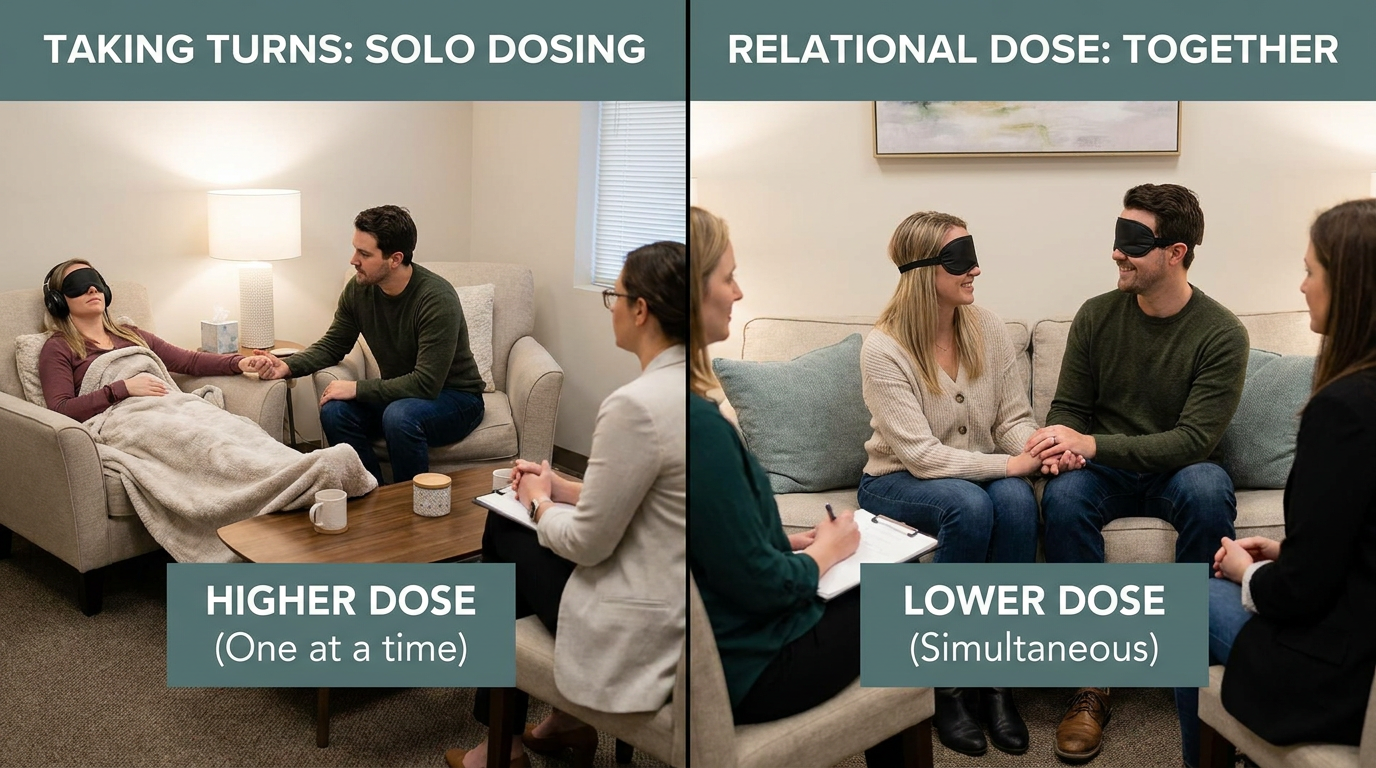
Model One: Taking Turns (Non-Simultaneous Dosing)
In this model, one partner receives ketamine — often at a fuller dose intended to support an inward, self-focused experience — while the other partner stays in the room and holds supportive space. At a later session, they switch.
The obvious question is why the second person is there at all, if the first person is turned inward. And the answer is the most emotionally interesting idea in this entire field.
Being witnessed in an open, undefended state — and witnessing your partner in theirs — can itself build trust and attachment.
Sit with what that means practically. In an ordinary week, you almost never see your partner without their armor on. You see the competent version, the tired version, the irritated version, the performing-fine version. What you rarely see is the person underneath all of it, unguarded and unable to manage your impression of them.
In this model, you do. One of you is soft and open and not curating anything. The other is present for it — quiet, attentive, safe.
And then you trade. Which means the person who was witnessed becomes the witness, and the vulnerability isn’t asymmetrical. Nobody is the patient. Nobody is the caretaker. You each take a turn being seen and a turn being the one who holds steady.
Couples frequently describe this — not the medicine session itself — as the most meaningful part. Something reorganizes when you have been genuinely gentle with each other while one of you couldn’t defend yourself. It’s difficult to argue the same way afterward. The story of who my partner is has a new piece of evidence in it that’s hard to dismiss.
The partner holding space is not incidental and not a bystander. That role is half the work, and it’s prepared for deliberately in advance. Being asked to simply be present, without fixing, without narrating, without managing — for many people that’s harder than dosing.
At Simply Being, this model runs as an arc of approximately eight sessions: individual preparation, a minimum of three joint couple-preparation sessions, alternating medicine sessions, and integration soon after each one.
Those preparation sessions aren’t administrative throat-clearing. They’re where you decide together what you’re hoping for, what you’re afraid of, what each of you needs from the other in the room, and what happens if something difficult surfaces. A couple that hasn’t done that work is not ready to dose, regardless of how motivated they are.
Model Two: A Lower Dose, Together (Simultaneous “Relational” Dosing)
In the second model, both partners take a smaller psycholytic dose — meaning a dose below the level that produces a full inward journey.
The practical consequence is significant: because neither partner disappears inside their own experience, both remain able to talk with each other and with the therapist throughout the session. This is not two people having private experiences in the same room. It’s a couples therapy conversation, conducted in a state where defenses tend to sit lower.
Couples in this model often find that conversations they’ve avoided for months become possible — not easy, but possible. The topic that usually triggers an immediate escalation gets discussed with more openness and less reactivity. There’s often more room to hear something hard without needing to immediately defend against it.
There’s also a structural advantage: because these sessions don’t require a separate multi-session arc built around individual journeys, they can be folded into regularly scheduled couples therapy. For couples already in ongoing work, that’s a lower-friction way to incorporate it.
Neither model is superior. They suit different couples, different goals, different comfort levels, and different clinical pictures. A couple wanting each partner to do deep individual processing within a relational container may fit the first. A couple whose central problem is that they cannot have a particular conversation may fit the second. Some couples are appropriate for neither, which is the subject of the next section.
How Simply Being Administers It
A few concrete specifics, because vagueness here is a warning sign in any provider.
At Simply Being, ketamine is administered as a self-administered sublingual lozenge, with every client first evaluated by an independent medical prescriber. The ketamine experience itself lasts approximately 2–2.5 hours, with the therapist present in the room throughout. Each session is intentionally tailored to the individual client, including the set and setting, to create an environment that supports their particular therapeutic needs.
Ketamine is not used as a stand-alone treatment. Whether used in individual or couples work, it is integrated into an established course of psychotherapy. Integration — the process of making sense of what surfaced during the ketamine experience and connecting it to the ongoing therapeutic work — ideally takes place within a day or two. This is where insights and experiences from the session can begin to be translated into meaningful therapeutic change.
Sara leads this work at the practice, under the clinical oversight described earlier.
That separation between prescriber and therapist is worth understanding rather than skimming. It means the person deciding whether ketamine is medically appropriate for you has no stake in whether you continue therapy, and the person doing therapy with you isn’t the one writing prescriptions. It’s a structural safeguard, and it’s a reasonable question to ask any provider you’re evaluating.
Which leads directly to the part of this article that matters most.
Screening, Safety, and When This Isn’t the Right Fit
Ketamine is not appropriate for everyone. Couples ketamine-assisted psychotherapy is not appropriate for every relationship. A responsible practice screens people out, and does it without apology.
If you take one thing from this article, consider making it this: a provider who is willing to tell you no is giving you information about their judgment that no amount of marketing can substitute for.
How Screening Works
At a general level, the process involves three layers.
An independent prescriber evaluation determines medical appropriateness. Certain medical and psychiatric conditions can make ketamine unsuitable — cardiovascular issues, certain psychiatric presentations, particular medication interactions, substance use considerations, and others. That determination is made by a qualified prescriber who has reviewed your actual history. It is not made by reading an article on the internet, including this one. Nothing here should be treated as medical advice or as an indication of whether you personally are a candidate.
A medical and psychiatric history review covers both partners individually, because in couples work there are two people whose safety has to be established, not one.
And a joint clinical assessment of the relationship itself asks a different question: not “is this medicine safe for these two bodies” but “is this relationship a context in which lowering defenses is safe?” Those are genuinely separate questions, and the second one is the one most easily skipped.
Intimate Partner Violence
This needs to be stated directly.
Couples ketamine-assisted psychotherapy is not appropriate for relationships involving active intimate partner violence.
The reasoning is straightforward and worth understanding rather than simply accepting. Every mechanism this work depends on — lowered defenses, increased vulnerability, greater emotional openness, reduced fear response — rests on an assumption that both partners are safe with each other. Where there is coercion, control, or violence, that assumption is false. Under those conditions, the same qualities that make this work potentially useful make it potentially harmful. Openness in front of someone who has used your openness against you is not therapeutic. It’s exposure.
This is not a judgment about anyone in that situation. People remain in relationships involving violence for reasons that are complicated, practical, financial, familial, and often invisible from outside. Nothing about that is a failing.
But the appropriate support is different. That means individual therapy with a clinician experienced in this area, specialized domestic violence services, and safety planning with people trained specifically for it. Those resources exist in Tennessee and nationally, and reaching out to them is not a smaller step than couples therapy — it’s a different and often more urgent one.
If you are in crisis, or thinking about suicide, or just need someone to talk to right now:
Call or text 988 to reach the 988 Suicide & Crisis Lifeline. It’s free, confidential, and available 24 hours a day, seven days a week. You can also chat online through the same link. You do not need to be in immediate danger to call — that’s a common misunderstanding, and it keeps people from reaching out who should.
No Guarantees
Some couples find this work valuable. Some don’t. Some aren’t candidates and won’t be.
That’s the whole honest statement. There are no promised outcomes, no cure claims, and no way to predict in advance which category any particular couple falls into. Given how thin the couples-specific evidence base is — 11 randomized controlled trials across the entire field of ketamine-assisted psychotherapy, with dyadic applications barely represented — anyone offering certainty is working from something other than the data.
Starting Somewhere Else Is Completely Reasonable
Couples ketamine work is not the right starting point for everyone, and it is not a more serious or more committed choice than ordinary couples therapy.
A great many couples do standard trauma-informed couples therapy, never consider a medicine session, and build genuinely different relationships. That path is complete in itself. It is not the beginner version, and choosing it is not settling.
Simply Being offers both individual and couples therapy services, and there’s no internal pressure toward the newer option. Some couples start with standard therapy and later ask about KAP. Some ask about KAP first and, after conversation, decide to start with standard couples work. Some ask, get screened, and are told it isn’t appropriate. All three are normal outcomes.
For those who do proceed, the most misunderstood part of the process comes after the medicine session — not during it.
Integration: What Happens After a Session
There’s a common assumption worth dismantling gently, because almost everyone arrives with it: that the medicine session is the treatment.
It isn’t. What a couple does with what surfaced is the treatment.
What Integration Actually Means
Integration refers to structured sessions held soon after each medicine session, in which partners process what came up, put language to it, and — this is the crucial part — translate whatever became visible into how they actually treat each other on an ordinary Tuesday.
Something surfaces in a session. Maybe one partner sees, with sudden clarity, that their withdrawal has always been about not wanting to become their father. Maybe the other feels, for the first time in years, how frightened they’ve been underneath all that pressing. Those are real and they can be moving.
They are also, by themselves, not change.
Insight is not behavior. Understanding why you shut down does not mean you will stop shutting down on Thursday when your partner uses that particular tone. Feeling profound tenderness toward someone during a session does not automatically survive contact with a bad night’s sleep and a disagreement about money. The gap between what became clear and what actually happens in your kitchen is where the work lives.
Integration is the bridge across that gap. It’s where you take something that felt luminous and make it operational: what does this actually change about how we do bedtime, or how we handle it when one of us gets quiet, or what we do in the first ninety seconds of a disagreement?
Why This Is Where Couples Therapy Earns Its Keep
The medicine may make material more accessible. It may lower the barrier to saying something true. But relational repair happens in conversation, over time, between two people who keep showing up.
This is the sense in which the ketamine is genuinely adjunctive rather than central. It may open a window. Someone still has to do the unglamorous work of climbing through it repeatedly, on days when nobody feels like it.
Integration is built into both models. It is not an add-on, not optional, and not something a couple can reasonably skip because the session felt complete on its own. The practice’s psychedelic integration therapy page describes how this phase is approached more broadly.
Honest Expectations
Integration can be slow. It can feel repetitive. Some sessions are quietly profound; others are two people struggling to articulate something that made complete sense at the time and now sounds thin out loud.
That’s normal. It’s also why the regulated-nervous-system material from earlier matters here — integration conversations go better when both partners are inside their window of tolerance rather than flooded or checked out. Part of what preparation builds is the capacity to have these conversations without the old pattern immediately reasserting itself.
If you’re hoping for a single session that resolves years of accumulated pattern, this is not that, and no responsible clinician will tell you it is.

With the process covered, here are the questions people most often ask before reaching out.
Frequently Asked Questions About Couples Therapy and Ketamine-Assisted Work in Nashville
What is ketamine therapy for couples?
Ketamine therapy for couples is couples therapy in which one or both partners receive a carefully dosed, supervised medicine session as part of an ongoing course of couples work, with preparation before and integration afterward. It’s not a stand-alone treatment and not a one-time event. Ketamine is used off-label for mental health applications.
Does couples therapy actually work?
Couples therapy helps many couples, and research on established couples therapy models is considerably stronger than research on ketamine-assisted couples work specifically. Outcomes depend on fit with the therapist, timing, and whether both partners engage. It isn’t guaranteed for anyone, and honest clinicians say so upfront.
How long does couples therapy take?
It varies widely. Some couples work on a focused issue over a few months; others continue longer, particularly when trauma histories are involved. There’s no fixed timeline, and any practice quoting you a precise number before meeting you is guessing. Your therapist should discuss expected scope with you directly.
What happens in the first couples therapy session?
Mostly listening. Your therapist will ask what brought you in, how the pattern between you typically unfolds, and what each of you hopes for. Nobody is asked to relive their worst moment on day one. You’re not required to agree about what the problem is — disagreement about that is normal and useful information.
Is ketamine legal for couples therapy in Tennessee?
Ketamine is a legal, FDA-approved anesthetic that can be prescribed off-label for mental health purposes under clinical supervision. It is not FDA-approved for depression, PTSD, anxiety, or relational applications. Off-label prescribing is legal and common across medicine, but it should always be disclosed plainly.
Do both partners have to take ketamine?
Not necessarily. In the non-simultaneous model, partners take turns — one doses while the other holds supportive space, then they switch at a later session. In the relational model, both take a lower psycholytic dose together. Both approaches are described in detail in the two-models section above.
How long does a ketamine session last?
The ketamine experience itself lasts approximately 2–2.5 hours, with your therapist present in the room throughout. That’s separate from the preparation sessions beforehand and the integration session afterward, which are scheduled as their own appointments. Plan the day accordingly rather than treating it as a standard therapy hour.
What’s the difference between couples counseling and marriage counseling?
Practically, very little — the terms are used interchangeably in Nashville and most places. “Marriage counseling” implies married partners; “couples counseling” and “relationship counseling” include unmarried, engaged, and long-term partners. Premarital counseling refers specifically to work done before a wedding. The therapy itself is largely the same.
Can we do couples therapy if only one of us wants to?
Yes, and this is far more common than people assume. One partner is usually more enthusiastic at the start. A reluctant partner attending because it matters to someone they love is a legitimate beginning. Individual therapy focused on the relationship is also a genuinely useful option if your partner isn’t ready.
Is ketamine-assisted couples therapy covered by insurance?
Do you offer couples therapy online?
For practical questions this article doesn’t cover, Simply Being’s FAQ page addresses how the practice operates day to day.

Where This Leaves You
Go back to the kitchen.
Same two people. Same argument, probably — these things don’t vanish, and anyone promising you they will is not being straight with you. But imagine it going differently. Not resolved. Different.
One of you notices, ninety seconds in, that your chest has gone tight and your voice has climbed, and you say so out loud instead of pressing forward. The other notices the pull to disappear and manages to stay in the room thirty seconds longer than usual. Somebody says the softer true thing instead of the sharp true thing. The loop gets interrupted rather than erased.
That’s what this work actually offers, on a good day. Not a different relationship. The same one, with a little more room in it.
Here’s the honest position, restated once so there’s no ambiguity: couples ketamine-assisted psychotherapy is an emerging practice with a limited evidence base. It is offered at Simply Being as one carefully structured option among several, by clinicians who will tell you plainly if it isn’t right for you — and who screen people out when it isn’t.
And standard trauma-informed couples therapy in Nashville is a complete and worthwhile path entirely on its own. Nobody has to choose the newer thing to be taken seriously here. Most couples don’t, and their work is no less real for it.
There’s no clock on this. Your relationship is not in more danger because you read an article and didn’t call. Take the time you need.
But it’s worth saying clearly: wanting things to be better between you is a reasonable place to start. It doesn’t have to be an emergency. It doesn’t have to be someone’s fault. It’s enough.
Reaching Out
If any of this sounds like something you’d want to talk about, you can contact Simply Being Therapy to ask about couples therapy in Nashville — or to ask specifically about ketamine-assisted couples work.
A few permissions worth granting yourself:
- You can reach out unsure. Ambivalence is not a disqualifier. Most people who call are ambivalent.
- Asking about it is not agreeing to it. You can ask every question you have about ketamine-assisted couples work and then decide it isn’t for you, or isn’t for you yet.
- Starting with standard couples therapy is completely reasonable. You can begin there and revisit KAP later, or never.
- You can reach out alone. Plenty of people make the first contact without their partner in the room, sometimes before they’ve even raised it. That’s a normal way to begin.
If you’d rather read before you write to anyone, the practice’s couples and individual therapy services page is a reasonable place to look around.
Couples therapy and couples ketamine-assisted psychotherapy at Simply Being are led by Sara Balter, LPC/MHSPA, MBA, MA, NCC, with clinical oversight of the practice’s psychedelic-assisted work by Dr. Barbie Hessel, LCSW, SEP, RSP, CPATP. All clinicians are licensed in Tennessee.
And once more, because it belongs at the end as much as the middle — if you’re in crisis, thinking about suicide, or simply need to talk to someone right now, call or text 988 to reach the 988 Suicide & Crisis Lifeline, any hour of any day.
This article is for general information and is not medical advice. Ketamine is not FDA-approved for the treatment of depression, PTSD, anxiety, or any psychiatric or relational condition; use for mental health purposes is off-label. Whether ketamine is appropriate for you is a determination made by a qualified prescriber who has reviewed your medical history — not by an article.