Ketamine Therapy in Nashville, TN: An Honest Guide to Ketamine-Assisted Psychotherapy
You typed ketamine therapy Nashville into a search bar, and what came back was a wall of clinic websites that all sounded roughly the same.
Some called it infusion therapy. Some called it ketamine-assisted psychotherapy. Some just called it ketamine treatment. Every site used slightly different language, none of them explained how they differed from one another, and most of them seemed more interested in getting you to book than in telling you what you’d actually be signing up for.
If you closed those tabs more confused than when you opened them, that’s a reasonable response to a genuinely confusing landscape.
People arrive at this search from a lot of different places. Depression that hasn’t lifted. Anxiety that’s been running in the background for years. Trauma that surfaces in ways that are hard to explain to people who haven’t lived it. The steady, grinding weight of stress that never quite resolves. Often, people arrive here having already tried several things — medications, therapy, lifestyle changes, some combination of all three — and they’re looking at ketamine therapy because they’re curious what else exists.
This article is not a pitch. It’s an educational guide.
Here’s what it will do: explain what ketamine actually is and what it is and isn’t approved for, describe the two main models of care you’ll encounter in Nashville and how they genuinely differ, walk through what the research currently supports and where it falls short, and give you the questions worth asking any provider you consider.
That last point matters more than it might seem. There is a medical or infusion model of ketamine care, and there is a ketamine-assisted psychotherapy (KAP) model. They are different experiences, built around different aims, delivered by different kinds of clinicians. Neither is an upgrade of the other. But almost nothing on page one of your search results explains the distinction, and it’s probably the single most useful thing you could understand before making a decision.
A brief note on who’s writing this. Simply Being Therapy is a boutique, trauma-informed psychotherapy practice in Nashville. Our clinicians hold advanced postgraduate training in Somatic Experiencing, EMDR, Internal Family Systems, attachment-focused therapy, and ketamine-assisted psychotherapy. We practice the KAP model specifically. We’ll say so plainly where it’s relevant, and we’ll try not to let it distort what we tell you about everything else.
One more thing, up front: ketamine is a legitimate area of clinical interest with a real but still-developing evidence base. In some areas the research is genuinely strong. In others it’s thin, mixed, or early. We’ll tell you which is which, including where the honest answer is less flattering to the treatment we offer.
Before you can decide whether any of this fits you, though, you need a clear answer to a question that’s surprisingly hard to find answered well: what is ketamine therapy, exactly?

What Is Ketamine Therapy? A Plain-Language Explanation
Let’s start with the medication itself, because most articles skip straight past it.
Ketamine was approved by the FDA for human use in 1970 — as an anesthetic. That’s its original and still-primary approved purpose. It has been used for more than five decades in operating rooms, emergency departments, ambulances, and battlefield medicine, and it carries a long safety record in supervised medical settings. The prescribing information available through DailyMed, maintained by the National Library of Medicine, reflects that anesthetic indication.
Now the part that clinic marketing tends to bury:
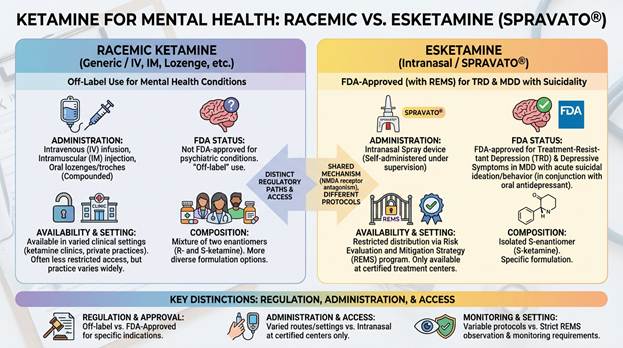
Ketamine is not FDA-approved to treat depression, PTSD, anxiety, or any other psychiatric condition. When ketamine is used for mental health, that use is off-label.
That deserves to be said early rather than discovered later.
Off-label prescribing is legal, common, and entirely routine across medicine. Physicians prescribe approved medications for unapproved uses constantly, drawing on clinical judgment and emerging evidence. It is not a loophole and it is not a red flag on its own. But it does mean something specific: the FDA has not formally reviewed and approved ketamine’s safety and effectiveness for psychiatric use, which is a different situation from a medication that has been through that process for that purpose. The FDA has published direct guidance on the current use of ketamine in emerging areas of therapeutic interest, and it’s worth reading in full if you want the regulator’s own words rather than ours.
Esketamine and Spravato Are Not the Same Thing as Ketamine
This distinction gets blurred constantly, sometimes carelessly and sometimes conveniently. They are different medications with different regulatory status, and conflating them muddies everything.
Esketamine is the S-enantiomer of ketamine — a specific mirror-image molecular form, isolated and developed as its own product. It’s delivered as an intranasal spray under the brand name Spravato, and unlike racemic ketamine, it is FDA-approved for psychiatric use.
The approval history matters:
- March 2019 — approved for treatment-resistant depression in adults, used in conjunction with an oral antidepressant.
- August 2020 — indication expanded to cover depressive symptoms in adults with major depressive disorder who have acute suicidal ideation or behavior, still alongside an oral antidepressant.
- January 2025 — approved as a monotherapy for treatment-resistant depression, meaning it can now be used without a co-prescribed oral antidepressant for that specific indication.
Esketamine is also available only through a restricted program called REMS (Risk Evaluation and Mitigation Strategy). Under REMS, it can only be administered in certified healthcare settings, patients must be enrolled, administration is supervised, and patients are monitored for at least two hours afterward. It cannot be dispensed for use at home. The full details are laid out in the FDA-approved Spravato prescribing information.
So: generic racemic ketamine used off-label for mental health, and FDA-approved intranasal esketamine under REMS, are two different things. If a provider uses those terms interchangeably, that’s worth asking about.
Why Ketamine Drew Psychiatric Interest in the First Place
Most conventional antidepressants act primarily on serotonin, norepinephrine, or dopamine. Ketamine works differently — it acts on the glutamate system, the brain’s most abundant excitatory neurotransmitter network.
That mechanistic difference is a large part of why researchers took interest. There’s an active line of investigation into whether ketamine may temporarily increase neuroplasticity — loosely, the brain’s capacity to form and reorganize connections — and whether that might open a window in which psychological change becomes more accessible than usual.
We want to be careful here, because this is where a lot of ketamine marketing goes off the rails. Neuroplasticity is a real phenomenon and a legitimate research question. It is not a settled explanation, and it should not be deployed as a scientific-sounding reason to buy something. What’s accurate to say is this: the mechanism is different from conventional antidepressants, that difference is genuinely interesting to researchers, and the full picture of how and why ketamine affects mood is still being worked out.
Is Ketamine Therapy Legal?
Yes. Ketamine is a Schedule III controlled substance under the Controlled Substances Act, which means appropriately licensed providers may legally prescribe and administer it. It is used lawfully in medical settings across the country every day.
Legal and FDA-approved-for-this-purpose are two different things, and this guide treats them as such throughout. Off-label use of a Schedule III medication by a licensed prescriber is lawful. It is simply not the same as an FDA-reviewed psychiatric indication.
Defining Ketamine-Assisted Psychotherapy
With that groundwork, here’s the model this practice offers.
Ketamine-assisted psychotherapy (KAP) is an approach in which the medicine is used inside an ongoing psychotherapy relationship, rather than as a standalone medical procedure. It has three components:
- Preparation beforehand, with your therapist
- A trained therapist present during the session itself
- Integration sessions afterward, to work with whatever came up
The medicine is one element within a course of therapy — not the whole of it.
Finally, and this belongs here rather than buried in fine print: ketamine therapy is not a first-line treatment. It is generally considered after other approaches have been tried without sufficient relief. Any provider who presents it as a starting point rather than a considered next step is not describing standard practice.
Understanding the medication is only half of what you need, though. Because in Nashville, this same medicine is offered inside two quite different models of care — and that difference is what almost no search result explains.
Two Models of Ketamine Care: Medical Infusion and Therapy-Led KAP
Before describing either model, one framing point that shapes everything below.
These are two legitimate approaches built around different aims. One is not a better version of the other. A person might be well served by either, by one and then the other, or by both at the same time. We practice one of them, and we’re going to describe the other fairly, because you can’t make a good decision on the basis of a rigged comparison.
The Medical and Infusion Model
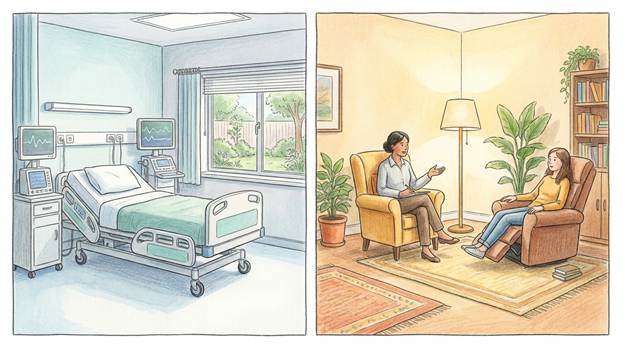
In this model, ketamine is administered in a clinical setting under medical supervision, with the primary aim of symptom relief — most often for treatment-resistant depression.
The provider is typically a physician, psychiatrist, nurse anesthetist, or similarly licensed medical clinician. Monitoring during the session is medical: vital signs, blood pressure, clinical observation. The session generally is not a psychotherapy session — a clinician is attending to your physical safety rather than conducting therapy — and patients typically return home afterward, with follow-up appointments scheduled as needed.
This is real, evidence-based care. As you’ll see in the research section, the medical model has the more established research footprint for treatment-resistant depression. Much of the strongest evidence supporting ketamine’s antidepressant effects comes from studies conducted in exactly this kind of setting. If someone tells you otherwise, they’re selling.
The Ketamine-Assisted Psychotherapy Model
In KAP, the medicine is one element within an ongoing therapeutic relationship, and the structure looks different:
- Before: preparation sessions with the therapist you’ll be working with, plus medical screening with a prescriber.
- During: a trained psychotherapist is present for the session, not solely monitoring but holding a therapeutic space.
- After: integration sessions, where you return to the material with your therapist in ordinary consciousness and work with what surfaced.
The aim is not only symptom reduction, but also the psychological work the medicine may make more accessible.
Here is the comparison in parallel form, with neutral language on both sides:
Medical / Infusion Model
- Primary aim: symptom relief
- Who is present: medical staff providing clinical monitoring
- Before the session: medical screening and intake
- After the session: follow-up and monitoring
- Delivered by: medical clinicians
- Evidence base: most established, particularly for treatment-resistant depression
Ketamine-Assisted Psychotherapy (KAP)
- Primary aim: symptom relief alongside therapeutic process
- Who is present: a trained psychotherapist, present throughout
- Before the session: medical screening plus preparation sessions
- After the session: integration psychotherapy sessions
- Delivered by: licensed therapists working alongside a prescriber
- Evidence base: emerging; research still developing
The Case for Integration — Framed as a Limitation, Not a Selling Point
This is the intellectual center of the article, and it requires care, because the honest version is less impressive than the marketing version.
Research consistently finds that the antidepressant effects of ketamine are frequently transient. Relapse commonly occurs within days to weeks in the absence of maintenance treatment or continued support. A systematic review of maintenance ketamine treatment for depression examines this durability problem directly, and it’s one of the most important things a prospective patient can understand.
That finding is the origin of the reasoning behind KAP. If the medicine opens something and then closes, the argument goes, the therapeutic work surrounding it is what might help translate a temporary shift into durable change.
It’s a reasonable hypothesis. It is not a proven one.
A systematic review of ketamine-assisted psychotherapy for treatment-resistant depression found exactly what an honest reader should expect from a young field: results across controlled trials are mixed, protocols vary enormously between studies, and the research is heterogeneous enough that firm conclusions are not yet warranted. Some studies suggest pairing ketamine with structured psychotherapy may help extend benefit. Others don’t show a clear advantage. The field has not settled this.
We practice KAP because we find the reasoning behind it clinically compelling and consistent with how we understand therapeutic change. That is a considered professional judgment, and we’re stating it as one — not as a research finding.
Questions to Help You Think About Fit
Rather than a verdict, some questions actually worth sitting with:
- Are you primarily seeking symptom relief, or hoping to do psychological work? Both are legitimate. They point in different directions.
- Do you already have a therapist, and would you want them involved? Coordination is common and often valuable.
- What kind of support do you want in the room? Some people want clinical monitoring and quiet. Others want a therapist they know.
- Is medical complexity a significant factor for you? If your health history is complicated, the intensity of medical oversight may matter more.
- Are you thinking about this as a short course or as part of longer-term care?
And an important note: these models are not mutually exclusive. Plenty of people receive ketamine in a medical setting while continuing psychotherapy elsewhere. Plenty of people do one at one point in their life and the other later.
Simply Being Therapy practices the KAP model specifically. That’s a factual description of what we do, not a claim about what you should choose.
Knowing that a therapist is present, though, doesn’t tell you much until you know what the days around a session actually involve.
What Ketamine-Assisted Psychotherapy Involves From the Inside
Most people considering KAP are nervous about it. That’s an appropriate response to an unfamiliar experience, and it’s worth demystifying the process end to end.
Preparing for Ketamine-Assisted Therapy
Preparation is not a formality. In this model, it’s a substantial part of the work.
Building the relationship. The therapist who will be with you during your session is someone you’ve already spent time with. That matters. A session is easier to hold well when the person holding it isn’t a stranger, and when you’ve had the chance to develop a sense of whether you feel safe with them. If you don’t, that’s important information — for you and for them.
Clarifying intentions. Preparation involves getting specific about what you’re hoping to work with. Not a goal to achieve, exactly — more an orientation. What are you carrying? What feels stuck? What would you like to be able to approach that you currently can’t? Intentions in this work function less like targets and more like a direction of attention.
Medical screening. A thorough review of your medical and psychiatric history is conducted with a prescriber. This covers cardiovascular history, psychiatric history, current medications and possible interactions, substance use history, pregnancy status, and other factors relevant to whether ketamine is appropriate for you. This is a clinical determination made by a qualified prescriber — not something a therapist, or a website, decides.
Practical planning. You’ll need transportation home; you cannot drive after a session. Clearing the rest of your day is strongly advised. Most people find they want quiet afterward rather than a return to meetings and errands. Think about what you’re going home to.
Emotional preparation. This is the part people skip, and it may be the most useful: saying your fears out loud. Fear of losing control. Fear that nothing will happen. Fear that something will. Fear of what might surface. Naming those with your therapist beforehand does real work, because it means that if something difficult arrives during the session, it arrives in a room where it has already been spoken about.
People frequently come to their first session nervous. Nervousness is expected and workable. It isn’t a problem to be solved before you can begin.
What a KAP Session Is Like
We’ll describe the shape of the experience rather than making promises about its content, because the honest answer is that experiences vary enormously.
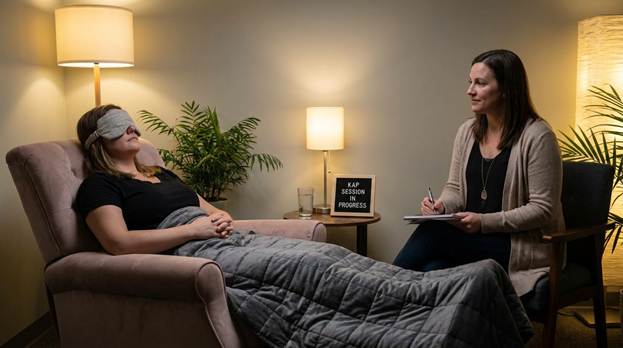
The setting is deliberately calm: a quiet, comfortable room, often a comfortable mat on the floor or couch, blankets, low light. Many people use an eye mask and music is played, which supports turning attention inward rather than outward. Your therapist is present the entire time. You can speak if you want to. You can stay silent if you’d rather. Both are fine.
What people report varies widely — between individuals, and between sessions for the same individual. Some describe emotional openness, or access to feelings that ordinarily stay out of reach. Some describe a shift in perspective on something familiar. Some describe a felt sense of distance from habitual thought patterns — the loops that usually feel inescapable becoming, temporarily, something they can observe rather than inhabit. Some describe dissociative sensations that feel genuinely unusual: altered perception of time, body, or self.
And some sessions are quiet and relatively uneventful. That happens, and it isn’t a failure.
We want to be direct about something: a session can be uncomfortable. Difficult material can surface. Emotions can arrive with more force than expected. Unusual perceptual experiences can be disorienting while they’re happening.
This is a substantial part of why a therapist is present. Not to prevent difficulty — difficulty is sometimes exactly where the work is — but so you’re not alone with it, and so there’s someone there whose job is to help you stay steady.
Working Within the Window of Tolerance
This is where our somatic orientation shapes how we practice KAP.
A central part of the therapist’s job during a session is helping you stay within a range where your nervous system can actually process what’s happening, rather than becoming overwhelmed by it. Clinicians call this the window of tolerance — the zone in which you’re activated enough to be engaged with difficult material, but regulated enough that you’re not flooded.
Outside that window in one direction, a nervous system goes into overwhelm — too much, too fast, and the experience becomes something to survive rather than work with. Outside it in the other direction, things shut down, go numb, go distant.
Neither state is where change happens. The work happens in the middle.
For anyone whose history includes trauma, this framing isn’t academic. Widening that window is often the entire point of the therapy. During a KAP session, a trauma-informed therapist is continuously reading where you are and helping you stay in that workable range — through pacing, presence, grounding, and sometimes simply by being a steady person in the room.
Integration: The Work After the Medicine
If preparation is what makes a session possible, integration is where lasting change is pursued.
Integration means returning to the material with your therapist in ordinary consciousness, and doing something with it. What surfaced? What did it mean? What does it change about how you relate to yourself, or to a relationship, or to a memory? And — the question that determines whether anything actually shifts — what do you do differently now?
An insight that stays an insight tends to fade. The research point from earlier applies directly here: benefits of ketamine are frequently transient without continued support and therapeutic work. Integration is the attempt to give a temporary shift somewhere to land.
Integration also isn’t a separate discipline. It draws on the rest of therapy. Depending on what emerges, integration work at our practice may involve Somatic Experiencing, EMDR, Internal Family Systems, or attachment-focused work. KAP doesn’t replace those modalities — it sits among them, and for many people, established trauma therapy is the more appropriate starting place.
Knowing the process, of course, raises the harder question: does it actually help, and for whom?
What the Research Shows About Ketamine — and What It Doesn’t
This field has a marketing problem. Enthusiasm has outrun evidence in a lot of public conversation, and someone making a real decision about their own care deserves a clear-eyed account of what’s well supported, what’s promising but early, and what simply isn’t known yet.
So here it is, condition by condition.
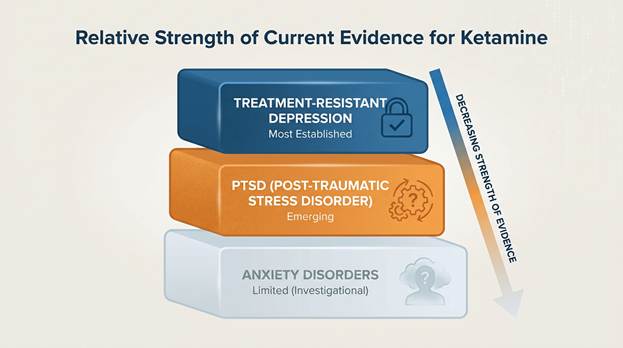
Treatment-Resistant Depression: The Strongest Evidence
This is where the evidence base is most developed, and it’s genuinely substantial.
Multiple randomized controlled trials, meta-analyses, and expert consensus reviews support rapid antidepressant effects of ketamine and esketamine in treatment-resistant depression — sometimes appearing within hours to days, which is markedly faster than conventional antidepressants typically work. An international expert consensus on ketamine and esketamine in treatment-resistant depression reflects the degree of agreement that has formed among clinicians and researchers working in this area.
For someone in Nashville researching depression treatment options after several medications haven’t produced sufficient relief, this is the part of the evidence base worth taking seriously. It is real, and it is the reason ketamine entered psychiatric practice at all.
It’s also worth restating that much of this evidence comes from medically supervised administration — the infusion and esketamine models described earlier.
If you are in crisis or having thoughts of suicide, you can call or text 988 to reach the 988 Suicide & Crisis Lifeline. It’s free, confidential, and available 24 hours a day, seven days a week. You don’t need to be certain you’re in crisis to call.
PTSD: Promising, but Genuinely Limited
Here the picture changes, and we’re going to be straightforward even though it complicates the case for a service we offer.
Evidence for ketamine in PTSD is considerably more limited and less consistent than for treatment-resistant depression. Studies are small. Follow-up periods are short. Results have been mixed.
Why tell you this when someone searching ketamine for PTSD in Nashville might prefer to hear otherwise?
Because it’s true, and because you’d find out eventually. And because there are trauma treatments with substantially stronger evidence — EMDR and other established trauma-focused therapies among them — that may be considered first, or alongside. Anyone presenting ketamine as a well-established PTSD treatment is ahead of the evidence.
Anxiety: Emerging
Some small studies suggest rapid anxiolytic effects across anxiety-spectrum conditions. A systematic review of ketamine for refractory anxiety-spectrum disorders found signals worth investigating further.
But the evidence is generally low-to-moderate quality, with small samples and limited long-term follow-up. For anyone in Nashville researching anxiety treatment, this is not established standard of care, and it shouldn’t be presented as one. Well-supported anxiety treatments exist and are typically where care begins.
The Durability Question
This point recurs because it should shape your expectations more than anything else on this page.
Benefits are frequently transient without maintenance treatment or continued therapeutic work. This is one of the most consistent findings in the literature, and it’s the reason maintenance protocols and integration models exist at all. If you go in expecting a durable change from a small number of sessions with nothing surrounding them, the evidence does not support that expectation.
And once more: ketamine is not a first-line treatment. It’s typically considered after other approaches have been tried. For many people — particularly those working with trauma — established modalities are the more appropriate place to begin, whether or not ketamine ever enters the picture.
From what the research says in general, the more personal question follows: is this reasonable for you?
Is Ketamine Therapy Right for You? Screening, Safety, and Fit
Let’s begin with the boundary, because it’s the most important thing in this section.
This article cannot tell you whether ketamine therapy is right for you. Neither can any website. That determination requires a conversation with qualified clinicians, including medical screening by a prescriber who knows your history. Anything else is guesswork dressed up as guidance.
What we can offer is a sense of how the question gets approached.
Who It Is Sometimes Considered For
Framed as “sometimes considered,” never as a recommendation:
- Adults who have tried other treatments for depression without sufficient relief
- People working with trauma who feel stuck in a therapy that is otherwise well-established and well-matched
- People already engaged in psychotherapy who are curious about a different avenue within it
Notice that each of these assumes something has already been tried. That’s consistent with ketamine not being a first-line treatment.
When It May Not Be Appropriate
Ketamine is not appropriate for everyone. Certain medical and psychiatric histories require careful evaluation — including some cardiovascular conditions, certain psychiatric presentations, pregnancy, and a history of substance use concerns, among others.
We’re deliberately not turning that into a checklist, because a list on a website is not a screening. These determinations are made by a qualified prescriber during medical screening, weighing your full history in context. Something on that list may not rule you out. Something not on it might. That’s precisely why screening exists and why no article can substitute for it.
Safety in Context
Ketamine has a long record of use in supervised medical settings, which is genuinely reassuring. It is also a controlled substance with real risks: sedation, dissociation, elevated blood pressure and heart rate, nausea, and potential for misuse.
Those risks are the reason the structure exists. Supervision, screening, a controlled setting, and a trained clinician present aren’t bureaucratic overhead — they’re the conditions under which the risks are managed.
This is also why at-home, unsupervised ketamine products marketed direct-to-consumer represent a meaningfully different situation. Consider the contrast: FDA-approved esketamine requires certified settings, patient enrollment, supervised administration, and at least two hours of post-dose monitoring, and cannot be dispensed for home use at all. An at-home product removes every one of those safeguards. The FDA has published consumer information about ketamine use for psychiatric conditions addressing these concerns. If you’re considering such a product, discuss it with a qualified provider first.
Setting Honest Expectations
Some people find ketamine therapy meaningful. Some find it unremarkable. Some decide, after a real conversation, that it isn’t for them or isn’t for them right now.
All three are legitimate outcomes. A good provider treats “no” and “not now” as valid conclusions of a consultation rather than obstacles to overcome. If you feel pressure to proceed, that itself is information about the provider.
This article is educational and is not medical advice. It does not create a therapeutic or clinical relationship, and it is not a substitute for consultation with a qualified healthcare provider who knows your history. Decisions about whether ketamine therapy is appropriate for you should be made with licensed clinicians, including medical screening by a prescriber.
Most people reach this point with a set of practical questions still unanswered — cost, insurance, legality, timing. Those deserve direct answers.
Ketamine Therapy FAQs: Cost, Insurance, Legality, and What to Expect
What is ketamine-assisted therapy?
Ketamine-assisted psychotherapy is a model in which ketamine is used within an ongoing psychotherapy relationship rather than as a standalone medical procedure. It has three phases: preparation sessions beforehand with your therapist, the medicine session itself with a trained therapist present throughout, and integration sessions afterward to work with what surfaced. Medical screening by a prescriber is part of the process. Ketamine is FDA-approved as an anesthetic; its use for mental health conditions is off-label. It is not considered a first-line treatment and is generally explored after other approaches have been tried.
How does ketamine-assisted therapy work?
Structurally, it works through the three phases above — preparation, session, integration — with each phase doing distinct work. Pharmacologically, ketamine acts on the glutamate system rather than primarily on serotonin, which differs from conventional antidepressants. Researchers are actively investigating whether ketamine temporarily increases neuroplasticity, potentially creating a period in which psychological change is more accessible. That’s an area of ongoing research, not settled science, and we’d encourage skepticism toward anyone who describes the mechanism with more certainty than the literature supports. You can read more about how we approach this work if you want additional depth.
How do I prepare for ketamine-assisted therapy?
Preparation happens on several levels. Clinically, you’ll complete a medical screening with a prescriber reviewing your health history and current medications. Relationally, you’ll spend time with the therapist who will be present during your session, building enough familiarity that the session can be held well. Psychologically, you’ll clarify what you’re hoping to work with and — importantly — name your fears about the experience out loud, so that difficult material arrives in a room where it’s already been discussed. Practically, arrange transportation home, since you cannot drive afterward, and clear the rest of your day. Arriving nervous is common and entirely workable.
Is ketamine-assisted therapy covered by insurance?
Frequently, no — though the answer is more layered than a flat yes or no. Coverage varies considerably by plan and depends on what’s being billed. The psychotherapy component and the medication or administration component may be handled quite differently by an insurer; psychotherapy sessions are sometimes billable when the ketamine-specific components are not. Esketamine (Spravato), because it is FDA-approved, is sometimes covered where off-label ketamine is not. Because this varies so much by individual plan and circumstance, the only reliable path is a direct conversation. You can contact Simply Being Therapy to discuss your specific situation.
How much does ketamine-assisted therapy cost?
Cost varies widely, and anyone quoting a single national figure is oversimplifying. The main variables: which model of care you’re pursuing, how many sessions are involved, whether medical and psychotherapy services are billed separately by different providers, and whether any portion is covered by insurance. A course of care involving preparation, medicine sessions, and integration is structured very differently from a standalone medical procedure, and the costs reflect that. For specifics relevant to your situation, reach out directly rather than relying on general figures.
Is ketamine-assisted therapy legal?
Yes. Ketamine is a Schedule III controlled substance under federal law, which means appropriately licensed providers may legally prescribe and administer it. It’s used lawfully in medical settings every day. What’s worth keeping distinct is the difference between legal and FDA-approved for this purpose. Ketamine is legal to prescribe, and its psychiatric use is off-label — the FDA has not reviewed and approved it for depression, PTSD, or anxiety. Off-label prescribing is legal and routine across all of medicine, but the distinction is worth understanding clearly.
Is ketamine-assisted therapy safe?
Ketamine has a long safety record in supervised medical settings, dating to its approval as an anesthetic in 1970. It also carries real risks, including sedation, dissociation, elevated blood pressure and heart rate, nausea, and potential for misuse. Those risks are why medical screening, supervision, and a structured setting matter — they’re the conditions under which ketamine is used responsibly. Ketamine is not appropriate for everyone, and suitability is determined by a qualified prescriber evaluating your full medical and psychiatric history. Unsupervised at-home use removes the safeguards that make supervised use reasonable.
What does ketamine-assisted therapy feel like?
Experiences vary widely — between people, and between sessions for the same person. Some describe emotional openness or access to feelings that are ordinarily hard to reach. Some describe a shift in perspective, or a sense of distance from habitual thought patterns. Some describe dissociative sensations: altered perception of time, body, or self, which can feel unusual. Some sessions are quiet and relatively uneventful. And some bring up difficult material or feel uncomfortable while they’re happening. We won’t promise any particular experience, because we can’t, and because the range is genuinely wide.
How many sessions will I need?
This varies by person and isn’t something that can be answered responsibly in advance or on a website. The number and pacing of sessions is determined collaboratively with your care team, based on your history, your goals, how you respond, and clinical judgment along the way. Be cautious of any provider offering a fixed package as an answer to this question before knowing anything about you.
Can I do ketamine therapy if I already have a therapist?
Yes, and this is common. Many people pursuing KAP already have an established therapeutic relationship they value and have no interest in leaving. KAP providers frequently coordinate with an existing therapist — sharing relevant information with your consent, aligning on what you’re working toward, and supporting integration work that continues in your ongoing therapy. Having a therapist you trust is an asset in this work, not a complication.
If you are in crisis or having thoughts of suicide, call or text 988 to reach the 988 Suicide & Crisis Lifeline, available 24/7.
How to Choose a Ketamine Therapy Provider in Nashville
Here’s a checklist you can take anywhere. These are questions worth asking of any provider you consider — including us.
- Which model of care is this? Medical/infusion, ketamine-assisted psychotherapy, or something else? Get a clear answer, not a blend of terminology.
- Who will be in the room with me during the session? A nurse? A physician? A therapist? Anyone at all, for the full duration?
- What preparation happens beforehand, and what integration support happens afterward? If the answer to either is “none,” that’s not disqualifying — but it tells you which model you’re in.
- Who handles medical screening and prescribing? There should be a clear, named answer.
- What specific training does the therapist have in this work? Not general licensure — training in ketamine-assisted or psychedelic-assisted therapy specifically.
- What happens if I decide partway through that this isn’t right for me? Listen closely to this answer.
- How does this fit with the rest of my mental health care? A provider who’s incurious about the rest of your treatment is seeing a procedure rather than a person.
What to Look for in Training
Training in this field is genuinely variable, because the field is new. Three things worth confirming:
Licensure as a psychotherapist. For KAP specifically, the person providing therapy should be a licensed mental health clinician.
Specific training in psychedelic-assisted or ketamine-assisted therapy. This is distinct from general clinical training. Certifications exist, programs vary in rigor, and it’s entirely reasonable to ask what someone completed and through whom.
A foundation in trauma-informed care. Given what can surface in these sessions, this matters. A clinician trained in working with trauma has a framework for what to do when difficult material arrives.
Asking directly is reasonable and welcome. Any provider who bristles at credential questions has answered a different question for you.

Where Simply Being Therapy Fits
Stated factually rather than comparatively.
Simply Being Therapy is a boutique, trauma-informed psychotherapy practice in Nashville. Our clinicians hold advanced postgraduate training in Somatic Experiencing, EMDR, Internal Family Systems, attachment-focused therapy, and ketamine-assisted psychotherapy. Treatment plans are individualized and integrative — built around the person rather than around a protocol.
Dr. Barbie Hessel, our founder, holds the CPATP (Certified Psychedelic-Assisted Therapy Provider) designation, the credential most directly relevant to this work.
KAP sits within the broader category of psychedelic-assisted psychotherapy, a field drawing significant clinical and research interest. We’d note that the term carries cultural associations that don’t always match the clinical reality — a KAP session is a quiet, structured, carefully held clinical process, not an adventure.
And we’ll say plainly what a marketing page usually wouldn’t: KAP is one option among several we offer, and for many people it isn’t the right starting point. Established trauma modalities have stronger evidence behind them and are frequently where care should begin. Sometimes the most useful outcome of a conversation about ketamine therapy is deciding to do something else first.

Ketamine Therapy in Nashville: What You Know Now
You started with a search bar and a wall of similar-sounding clinics. Here’s where you’ve landed.
You know that ketamine is FDA-approved as an anesthetic, and that its use for mental health is off-label — legal, common, but not the same as an approved psychiatric indication. You know that esketamine, sold as Spravato, is a separate medication with its own FDA approval and its own restricted program. You know that ketamine therapy in Nashville is offered through two genuinely different models, and that neither is a lesser version of the other.
You know where the evidence is strong, and where it isn’t. Treatment-resistant depression has the most established research behind it. PTSD does not, although there is promise. Anxiety research is early.
You know that effects are frequently transient without continued work. And you know what to ask anyone you consider.
Our honest position, stated without hedging: ketamine therapy is not a cure, not a first-line treatment, and not right for everyone. For some people, within the right structure and with real integration work, it becomes a meaningful part of care. Both halves of that sentence are true.
Healing is rarely one-size-fits-all. A good plan is individualized and integrative, and it accounts for the whole person rather than a single intervention.
The aim of this work isn’t transformation on a schedule. It’s something quieter — feeling better oriented to your present, and more prepared to build a future you can look toward.
If You’d Like to Talk
If you’re wondering whether ketamine-assisted psychotherapy fits your situation, you’re welcome to reach out to Simply Being Therapy and talk it through — or to ask about our other trauma-informed approaches, which may be the better place to start. You can also learn more about Dr. Barbie Hessel if you’d like to know who you’d be speaking with.
And if you’re not ready, that’s completely reasonable. Reading, sitting with it, and revisiting the question later is a perfectly good way to approach a decision like this one.
This article is educational and is not medical advice. If you are in crisis, call or text 988 to reach the 988 Suicide & Crisis Lifeline, free and confidential, 24/7.